Data Academy
What Is a Data Warehouse? How Data Warehousing Has Evolved
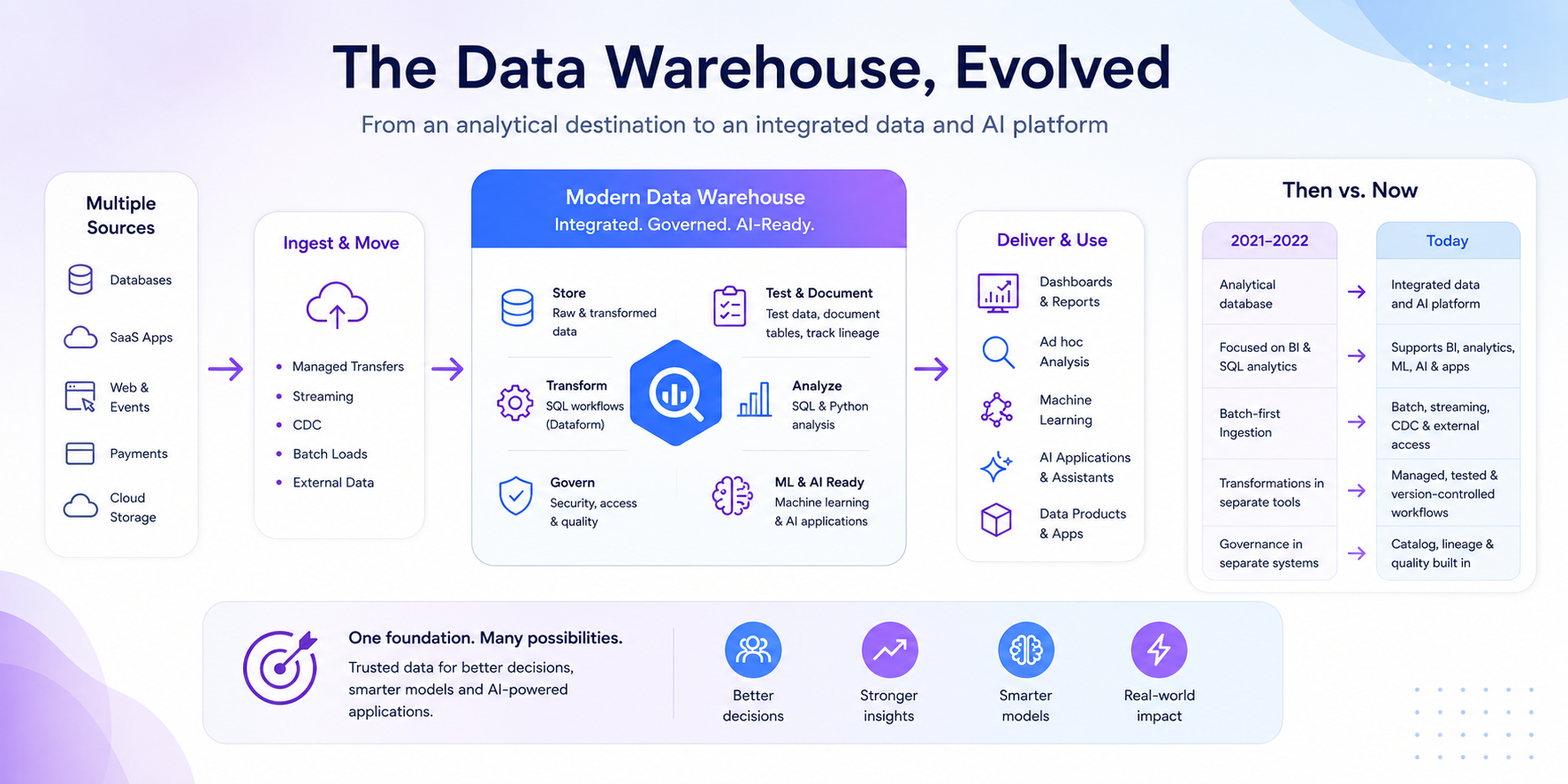
In 2022, I published an article on Built In explaining data warehousing. I defined a data warehouse as follows:
A data warehouse is a digital environment for data storage that provides access to current and historical information for supporting business intelligence activities. Consequently, data warehousing is the process of periodically archiving and reshaping data for business intelligence purposes.
That definition still captures the central purpose of a data warehouse: bringing data together and preparing it so an organisation can understand its performance and make informed decisions.
However, the definition now feels incomplete.
The phrase “periodically archiving” suggests that data arrives mainly through scheduled batch processes. “For business intelligence purposes” positions the warehouse primarily as a source for reports and dashboards.
Both were reasonable ways to explain data warehousing. Today, however, platforms such as BigQuery support a much wider data lifecycle. They help teams ingest, transform, test, document, govern and analyse data. They can also support machine learning, AI applications and continuously updated operational use cases.
The data warehouse has not stopped being a place for current and historical information. It has expanded from an analytical destination into a broader data platform.
What Is a Data Warehouse?
A data warehouse is a system that integrates information from multiple sources and organises it for analysis.
It normally contains both current and historical data, allowing an organisation to study changes over time. A warehouse might combine customer records, website events, product information, advertising data, sales transactions and financial results.
Instead of examining these sources independently, the organisation can use the warehouse to answer questions that cross several systems:
- Which marketing channels generate the most valuable customers?
- How has product adoption changed over time?
- Which customer behaviours are associated with cancellations?
- How accurate were previous sales forecasts?
- How did a product update affect engagement and revenue?
Oracle describes a data warehouse as a system designed to support business intelligence and analytics by consolidating information from many sources. Qlik similarly emphasises unified historical data, but extends its uses to data analysis, artificial intelligence and machine learning.
The defining value of the warehouse remains consistent: it turns fragmented operational data into information that people can understand and trust.
What Has Not Changed?
The technology has evolved, but several fundamental characteristics remain important.
Data still needs to be integrated
Information from different systems rarely arrives in a consistent format. Two applications might use different customer identifiers, currencies, date formats or definitions of revenue.
A warehouse provides a place to reconcile those differences and create common business definitions.
Historical information still matters
Operational applications usually focus on the latest state of a transaction. A warehouse preserves changes over time.
Historical records allow teams to compare periods, identify trends, measure the effect of decisions and train forecasting models.
Analytical and transactional workloads remain different
A transactional database is designed to record activities such as purchases, payments and account updates. A warehouse is designed to analyse large groups of records.
Separating these workloads allows organisations to run complex analytical queries without placing unnecessary pressure on the systems that operate their products.
Data quality remains essential
A powerful warehouse cannot repair an unclear business definition automatically. If two teams calculate active customers differently, moving their data into the same platform will not make the disagreement disappear.
A warehouse still needs ownership, documentation, testing and agreed definitions.
The Evolution Is Not Simply From On-Premises to Cloud
It would be inaccurate to describe the change since 2022 as a transition from traditional on-premises warehouses to modern cloud warehouses.
Cloud data warehouses were already firmly established. BigQuery was already serverless and scalable, with separate storage and computing layers. Teams were using it for SQL analysis, ELT, business intelligence, streaming workloads and machine learning.
The more useful comparison is:
A cloud data warehouse as it was commonly used four or five years ago versus the wider, more integrated data platform it is becoming today.
Around 2021 and 2022, BigQuery frequently acted as the central analytical database within a larger collection of tools. Data ingestion, transformation, workflow orchestration, data quality, documentation and governance could involve custom pipelines or separate products.
Those external tools have not disappeared. What has changed is how many of these responsibilities are now available within, or closely integrated with, the warehouse ecosystem.
Google currently describes BigQuery as an “AI-ready data platform,” rather than only as a cloud data warehouse. That positioning reflects the expansion of its role.
The evolution is cumulative. Many modern capabilities existed in some form several years ago. They have since become more integrated, accessible and central to how data warehouse platforms are designed and presented.
From Analytical Destination to Data Platform
A data warehouse was often described as the final destination of a data pipeline.
Data was extracted from operational systems, cleaned and transformed, loaded into the warehouse and then accessed through a business intelligence tool.
That sequence still exists, but it no longer captures the whole platform.
A modern BigQuery environment can participate in several parts of the data lifecycle:
- Moving data from source systems
- Storing raw and transformed data
- Running transformation workflows
- Testing and documenting datasets
- Managing metadata, quality and access
- Supporting SQL and Python analysis
- Training machine learning models
- Providing data to dashboards, applications and AI systems
The warehouse is no longer only where the pipeline ends. It is also where a growing amount of data engineering, governance and analysis happens.
Data Movement Has Become Part of the Warehouse Experience
A warehouse is only useful when data can reach it reliably.
Several years ago, teams commonly relied on custom pipelines or dedicated integration products to extract data from their applications. Those approaches remain valuable, especially for complex requirements, but warehouse platforms now provide more managed ingestion options.
The BigQuery Data Transfer Service automates scheduled data movement into BigQuery. Its supported sources span Google services, SaaS platforms, marketing systems, operational databases, other data warehouses and cloud storage.
Scheduled transfers are only one option. A contemporary BigQuery architecture can use:
- Batch loading for large periodic datasets
- Managed transfers from supported platforms
- Streaming ingestion for events generated in near real time
- Change data capture for replicating database changes
- Federated queries for accessing external data without loading it first
- External tables for working with data stored outside BigQuery
This makes “periodically archiving data” only one part of modern data warehousing.
Some datasets still arrive once a day or once a month. Others are continuously updated. In some cases, the data does not need to be moved into the warehouse before it can be queried.
ELT Has Become More Integrated and Managed
The traditional ETL sequence is extract, transform and load. Data is prepared before it reaches the warehouse.
Cloud computing encouraged greater use of ELT: extract, load and transform. Teams load data first and use the warehouse’s computing engine to transform it.
ELT was already well established by 2022. The newer development is not the invention of ELT, but the availability of more integrated tools for managing transformation workflows.
Dataform allows analysts and engineers to develop, test, document, version and schedule SQL transformations in BigQuery.
With Dataform, a team can:
- Store transformation code in Git
- Review changes before deploying them
- Define dependencies between tables
- Visualise a workflow’s dependency tree
- Test the quality of source and output data
- Document tables alongside their SQL
- Schedule and monitor workflow execution
- Reuse transformation logic across datasets
This treats SQL transformations more like software.
Consider a revenue table used by senior leaders. Without a managed workflow, its logic might live in a long scheduled query understood by one analyst. If that query changes, the team may struggle to see who changed it, why it changed or which reports depend on it.
With a managed transformation project, the logic can be reviewed, tested, documented and traced through its dependencies.
The warehouse is therefore becoming more than the engine that executes SQL. It is part of a development environment for producing trusted analytical data.
Business Intelligence Is Still Important, but It Is No Longer the Only Output
Reports and dashboards remain central data warehouse use cases. They help teams monitor sales, understand customers and measure business performance.
Modern warehouses also support a broader group of users and workloads.
Databricks includes reporting, analytics, data applications and machine learning preparation among current data warehouse uses. BigQuery provides integrated capabilities for machine learning, geospatial analysis, search, notebooks and Python-based workflows.
The same governed dataset might now support:
- A Looker or Power BI dashboard
- An ad hoc SQL investigation
- A forecasting model
- A customer segmentation process
- An anomaly-detection system
- A recommendation engine
- A generative AI application
- A customer-facing data product
- An automated operational workflow
For example, a table containing customer orders might feed a finance dashboard, help train a demand forecast and provide context to an AI assistant.
The warehouse has become a shared foundation for decisions, models and applications—not only visual reports.
The Boundary Between Warehouses and Data Lakes Has Weakened
Traditional data warehouses were associated with structured, carefully modelled data. Data lakes provided inexpensive storage for raw, semi-structured and unstructured information.
This created a relatively simple distinction:
- Use a warehouse for trusted reporting and SQL analytics.
- Use a lake for large volumes of raw or unstructured data.
The distinction has become less rigid.
The lakehouse model combines the flexibility of data-lake storage with capabilities associated with data warehouses, including reliable tables, governance and analytical performance. Databricks presents the lakehouse as an evolution of the traditional warehouse architecture.
Warehouse platforms have moved in the other direction by supporting more data types and external storage patterns. BigQuery can work with structured and unstructured data and supports open table formats such as Apache Iceberg, Delta and Apache Hudi.
It can also query some data stored in Cloud Storage, operational databases, Google Sheets and other external sources.
This does not make every warehouse a lakehouse or remove the architectural differences between them. It does mean that organisations have more flexibility over where data is stored and how it is accessed.
The important question is no longer simply whether an organisation needs a warehouse or a lake. The better question is how different users and workloads can access reliable data without unnecessary movement, duplication or complexity.
Governance Has Moved Closer to the Platform
As the warehouse supports more data and more users, discovering and understanding that data becomes harder.
A table name alone rarely explains:
- Where the data originated
- Who owns it
- When it was last updated
- Which transformations were applied
- Whether it passed quality checks
- Which dashboards or models depend on it
- Who is allowed to access it
Modern platforms increasingly address these questions through integrated governance capabilities.
BigQuery currently includes features for metadata management, discovery, lineage, data quality and controlled sharing. Dataform complements these capabilities by documenting transformations, declaring dependencies and testing datasets.
Governance is not only about restricting access. It helps people decide whether a dataset is appropriate for a particular analysis.
As the warehouse becomes easier to populate, this context becomes more important. More data does not automatically produce more useful information. Without ownership and documentation, a warehouse can become a collection of tables that people are afraid to use.
Cloud Data Warehousing: Then and Now
| Cloud data warehouse circa 2021–2022 | Modern data platform today |
|---|---|
| Already cloud-based, elastic and often serverless | Retains those capabilities while covering more of the data lifecycle |
| Commonly positioned as an analytical database | Increasingly positioned as a complete data and AI platform |
| Primarily associated with BI, reporting and SQL analytics | Supports BI, analytics, ML, AI and data applications |
| Batch ingestion with existing streaming and transfer options | Wider integration of transfers, streaming, CDC and external data access |
| ELT already performed with warehouse compute | ELT managed through more structured, tested and version-controlled workflows |
| Transformations and orchestration often spread across separate tools | More workflow capabilities integrated into the warehouse ecosystem |
| Focused mainly on structured and semi-structured data | Expanding support for unstructured data and open table formats |
| Governance frequently handled through separate systems | Cataloguing, lineage and data quality moving closer to the platform |
| Mainly consumed by analysts, engineers and BI teams | Shared with data scientists, applications and AI systems as well |
This comparison does not imply that every organisation uses all these capabilities. Nor does it mean they appeared overnight.
It shows that the expected scope of a data warehouse has expanded.
What Does a Modern BigQuery Workflow Look Like?
A modern BigQuery environment might operate as follows:
- Managed transfers import data from advertising, CRM, payment and operational platforms.
- Streaming services collect website and application events as they occur.
- Change data capture replicates updates from operational databases.
- Raw data is loaded into BigQuery or accessed through external tables.
- Dataform transforms the source data into tested and documented business tables.
- Governance tools record metadata, lineage, ownership and access policies.
- Business intelligence tools use the curated data for dashboards.
- Analysts and data scientists use the same foundation for exploration and machine learning.
- Applications and AI systems use selected datasets to deliver predictions, recommendations or automated actions.
In this architecture, BigQuery is not simply the database at step four. It participates in data movement, transformation, governance, analysis and delivery.
Modern Tools Do Not Remove Data Warehousing Risks
Greater integration can reduce manual work, but it does not eliminate the risks associated with data warehousing.
Source systems can still send incomplete or incorrect information. Schema changes can still break pipelines. A transformation can run successfully while applying the wrong business logic.
Modern platforms also introduce new concerns:
- Poorly controlled queries can create unexpected costs.
- Real-time data can give users incorrect answers more quickly.
- More integrations can make ownership unclear.
- AI systems can amplify problems in unreliable source data.
- Easier access can increase privacy and security risks.
Tools such as Dataform, metadata catalogues and data quality tests help teams manage these problems. They do not replace careful engineering or communication between technical teams and business stakeholders.
The quality of a warehouse still depends on the quality of the decisions behind it.
An Updated Definition of a Data Warehouse
My 2022 definition focused on storage, historical information and business intelligence:
A data warehouse is a digital environment for data storage that provides access to current and historical information for supporting business intelligence activities.
The essence of that definition remains valid. I would now expand it:
A data warehouse is a governed analytical data platform that integrates current and historical information from multiple sources, transforms it into trusted and reusable datasets, and makes it available for business intelligence, analytics, machine learning, AI and data applications.
Under this updated definition, data warehousing is not only the periodic archiving and reshaping of data. It is the ongoing practice of moving, modelling, testing, documenting, governing and serving data across an organisation.
The data warehouse still helps a business look back. It preserves history, supports reporting and provides consistent measures of performance. What has evolved is its reach. A modern warehouse can also help an organisation understand what is happening now, predict what may happen next and build products that act on those insights.
Turn your data into trusted answers
Build governed metrics, explore your data, and create dashboards with Metricwise.
Get Started