Analytics
Semantic Model vs Semantic Layer: What’s the Difference?
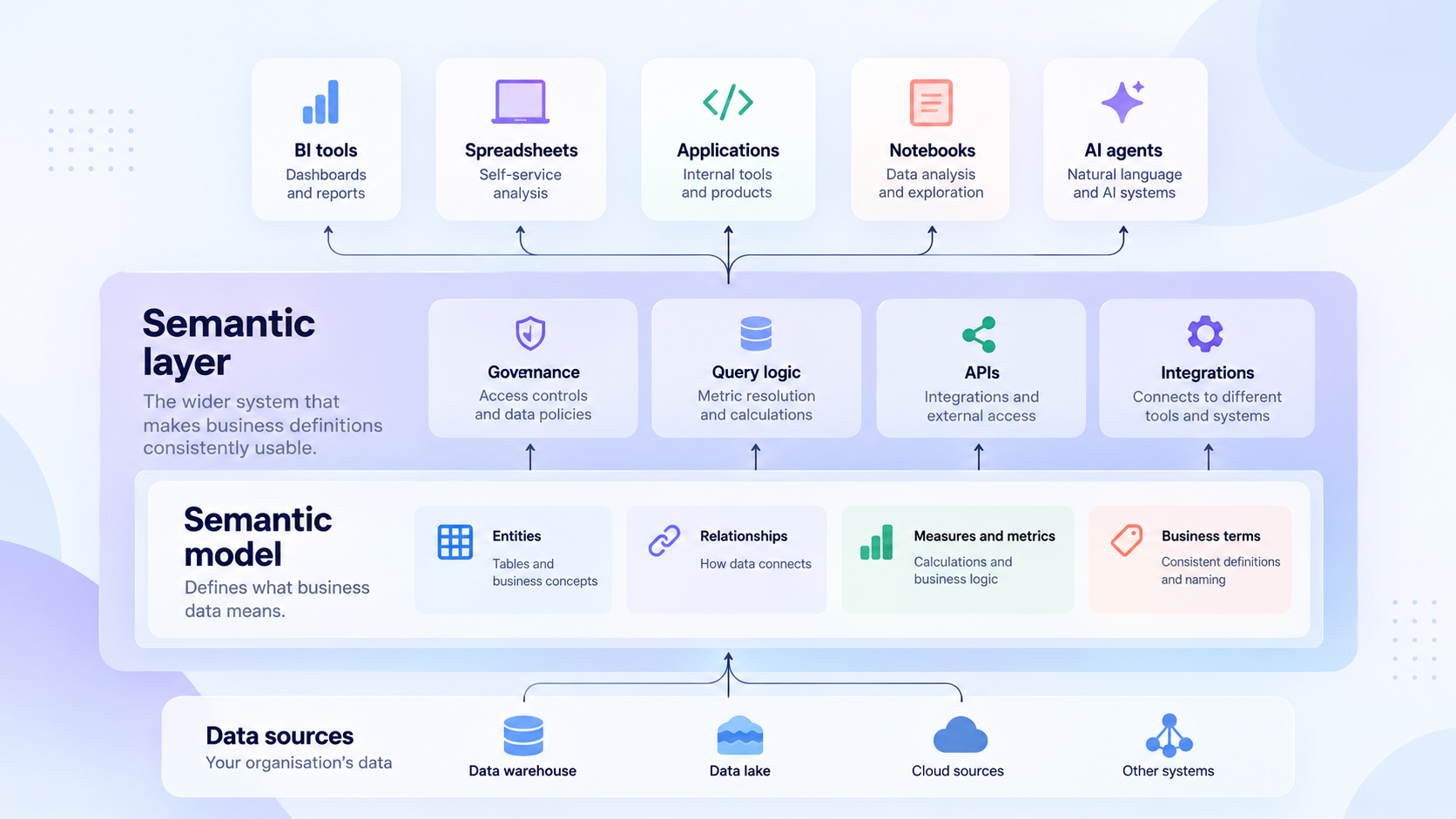
A semantic model defines all the formulas and business logic, while a semantic layer is the broader architecture that makes those definitions available consistently to the systems using the data. A semantic model can therefore be thought of as a core component of a semantic layer.
The distinction becomes confusing because software vendors do not use the terms consistently. Microsoft primarily talks about semantic models in Power BI, Looker uses both semantic models and semantic layers, while dbt explicitly describes semantic models as part of its wider Semantic Layer. The terminology varies, but the underlying architectural distinction is useful.
| Semantic model | Semantic layer | |
|---|---|---|
| Purpose | Defines what business data means | Makes those definitions consistently usable |
| Contains | Entities, dimensions, relationships, measures and metrics | Semantic models, query logic, governance, APIs and integrations |
| Example | Defining revenue and its valid dimensions | Making the revenue definition available to BI, AI and applications |
| Relationship | Usually a core component | The broader system around the model |
What is a semantic model?
A semantic model is a set of rules, calculations, definitions and relationships built on top of one or more data tables to give the data consistent meaning for business intelligence and analytics.
A semantic model adds that meaning. It can define which table represents an order, how customers relate to orders, which field represents the order date and how metrics such as revenue should be calculated. It can also define which dimensions are valid for a metric and how measures should aggregate.
Consider a calculation such as SUM(order_amount). It may look like revenue, but several business decisions are still unresolved. Should cancelled orders be included? Should refunds be deducted? Does the figure include tax? Should revenue belong to the date the order was created, completed or paid?
The semantic model is where those decisions can be represented explicitly rather than being left to individual dashboards or analysts.
Microsoft describes a Power BI semantic model as a logical representation of an analytical domain containing metrics, business-friendly terminology and other representations. Its documentation also describes semantic models as providing a business-friendly layer over enterprise data, including predefined metrics, relationships and reusable calculations.
Where does the semantic layer fit?
The semantic layer is the broader environment through which those definitions are governed and consumed. It can contain one or more semantic models alongside capabilities such as query generation, metric resolution, access controls, APIs and integrations.
A simplified architecture looks like this:

This distinction becomes important once an organisation has several ways of consuming data. If revenue is defined correctly inside one dashboard, that dashboard may always show the right number. Another analyst could still create a second dashboard using slightly different logic, while a spreadsheet or internal application could introduce another definition.
The company has defined revenue, but the definition is tied to one implementation. A semantic layer attempts to make that business meaning reusable so different consumers do not need to recreate it independently.
This is also why a semantic layer is broader than a metrics layer. A metrics layer concentrates on governed metric definitions, while a semantic layer can represent a wider set of business concepts, relationships and dimensions.
Semantic model vs semantic layer: the key difference
The difference becomes particularly clear when metrics are involved.
Suppose several teams report customer acquisition cost. Marketing calculates CAC as marketing spend divided by new customers. Finance includes sales expenditure. Another analyst excludes brand advertising, while another attributes customers according to the month in which the lead was created rather than the month in which the customer converted.
Every report could still contain a metric called CAC, despite answering a different question.
A semantic model can define exactly what CAC means, including its calculation, relationships, dimensions and time logic. The semantic layer can then make that definition available wherever CAC is requested.
This becomes more important as the number of analytical interfaces grows. A traditional environment might have followed a relatively simple path from warehouse to BI tool to dashboard. Modern environments can have BI platforms, notebooks, spreadsheets, internal applications and AI systems consuming the same underlying data.
The semantic model addresses the definition. The semantic layer addresses how that definition is governed, queried and reused. For a broader explanation of the latter, see our guide to what a semantic layer is in business intelligence.
Why Power BI, Looker and dbt use different terminology
There is no universal standard defining exactly where a semantic model ends and a semantic layer begins. Vendor terminology often reflects how the technology is packaged.
Microsoft strongly favours the term semantic model. Power BI semantic models contain relationships, measures, calculations and business terminology, and Microsoft itself describes them as a semantic layer over enterprise models in some of its architecture guidance. Its more recent documentation also notes that vendors such as dbt, Cube, Snowflake and Databricks use different names for products targeting similar semantic use cases.
Looker uses both concepts. Google describes LookML as the language used to create semantic data models containing dimensions, calculations, aggregates and relationships. Looker then uses those models to construct queries against the underlying database.
dbt makes the hierarchy particularly explicit. Its documentation states that semantic models are the foundation for data definition in MetricFlow, which powers the dbt Semantic Layer. The wider Semantic Layer also includes interfaces, APIs and a service layer for querying metrics from downstream tools.
The useful distinction is therefore architectural rather than terminological. A vendor may call a product a semantic model, semantic layer, semantic view or something else while solving overlapping problems.
Why this matters more with AI
AI analytics makes weak semantic definitions easier to expose.
Suppose an AI assistant can access tables called customer, deal, lead, application and transaction, and a user asks: “What was our conversion rate last month?”
The schema alone does not tell the AI what counts as a conversion, which date determines the month, whether duplicate applications are possible or which records should be excluded. The system can generate perfectly valid SQL while still answering the wrong business question.
A semantic model provides much of that missing context. The semantic layer can then make those definitions available to an AI system in the same way they are made available to other analytical consumers.
Microsoft makes this dependency explicit in its Copilot guidance, warning that semantic models and their underlying data need to be prepared properly or Copilot can produce inaccurate or misleading results.
This is one reason semantic modelling has become more important as AI changes business intelligence. Natural-language interfaces make it easier to ask questions, but they do not remove ambiguity from the business definitions underneath them.
Does every company need a separate semantic layer?
Not necessarily. A company using one BI platform for almost all reporting may already centralise enough logic through that platform's semantic models.
Introducing another semantic technology simply because the organisation does not currently have something labelled a “semantic layer” can create another modelling system to maintain. A better question is where important definitions such as revenue, conversion rate and active customers currently live, how often those definitions are recreated, and whether different systems can consume them consistently.
If the same metric is repeatedly rebuilt across dashboards, applications and AI tools, a broader semantic layer becomes more valuable. If one governed model already serves nearly every analytical use case, another layer may add little.
Frequently asked questions
Is a semantic model the same as a semantic layer?
Not exactly. A semantic model represents business concepts, relationships, dimensions and metrics. A semantic layer is the broader architecture through which those definitions can be governed, queried and exposed to data consumers. In practice, some vendors use the terms interchangeably or package both capabilities within the same product.
Does a semantic model live inside a semantic layer?
Conceptually, yes. A semantic model can be considered a core component of a semantic layer. dbt provides a clear example: its semantic models define business logic and relationships used by MetricFlow, while its wider Semantic Layer provides the services and interfaces through which those definitions are queried.
Is Power BI a semantic layer?
Power BI is a business intelligence platform that includes semantic layer capabilities. Microsoft calls the models used within Power BI semantic models. These models define relationships between tables, business metrics, calculations and terminology, allowing reports to use consistent definitions.
Power BI semantic models can also be shared across reports and accessed by external tools through interfaces such as the XMLA endpoint. This means they can function as a semantic layer, providing a common set of business definitions for multiple applications.
The distinction is that Power BI is the wider BI platform, while its semantic models provide the underlying semantic functionality. A semantic layer does not necessarily have to be a separate product or component.
Turn your data into trusted answers
Build governed metrics, explore your data, and create dashboards with Metricwise.
Get Started