Data Academy
Data Engineer vs Analytics Engineer in 2026: What’s the Difference?
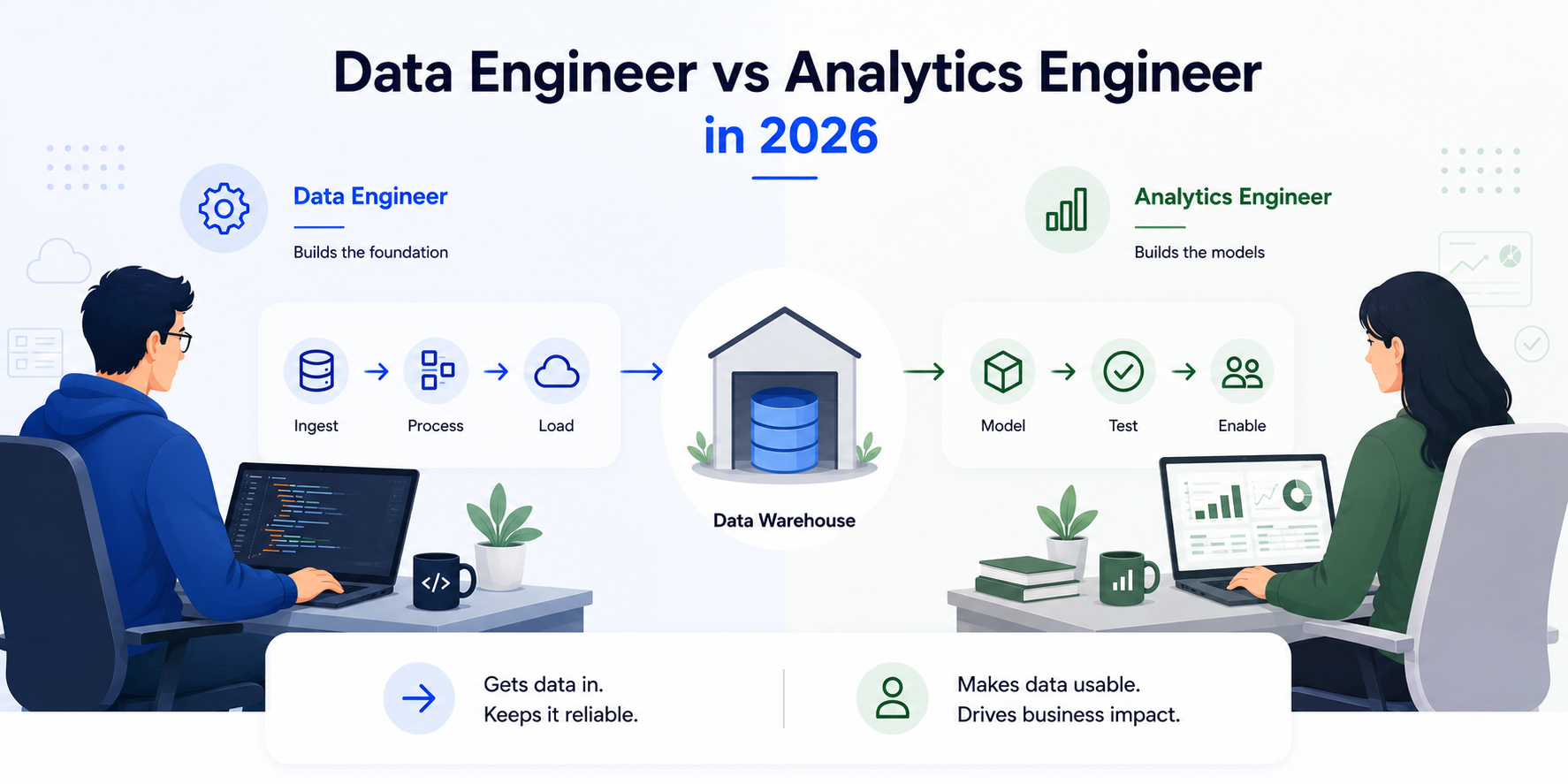
Data Engineer vs Analytics Engineer: What Is the Real Difference?
The difference between a data engineer and an analytics engineer used to feel clearer than it does today.
Historically, data engineers were the people building the pipelines. They were responsible for getting data out of source systems, moving it somewhere useful, and transforming it along the way. In the classic ETL model, a lot of the heavy lifting happened before the data reached the warehouse, so data engineers often wrote transformation logic in Python, Scala, or similar languages. That made sense when data platforms were more limited and when transformation work had to happen outside the warehouse.
Cloud warehouses changed that pattern. Instead of transforming data before loading it, many teams moved towards ELT: extract the data, load it into the warehouse, then transform it there. As warehouses became more powerful, they could handle much of the transformation work directly. SQL became the main language for shaping data into clean, trusted models.
That shift created more space for the analytics engineer.
Where the Roles Usually Split
An analytics engineer usually works closer to the business layer. Their job is to take raw or lightly processed data and turn it into models that analysts, dashboards, and business teams can rely on. They write SQL, build models in tools like dbt, Dataform, or Coalesce, add tests, document logic, and help make sure metrics are defined consistently.
In simple terms, the data engineer often focuses on moving and processing data. The analytics engineer focuses on modelling that data so the business can actually use it.
But that simple split does not always hold. In large organisations, the divide can be real. A data engineer might own ingestion, orchestration, streaming, Spark jobs, infrastructure, and platform reliability. An analytics engineer might own warehouse models, metric definitions, BI readiness, and the transformation layer closer to reporting.
In smaller companies, the lines are much blurrier. One person might build ingestion pipelines, write dbt models, fix dashboard issues, manage data quality checks, and help the finance team understand why revenue numbers changed. In that kind of environment, the title matters less than the actual work being done.
The Tooling Does Not Tell the Whole Story
There is also a misconception that all data engineers need to work with big data tools like Databricks or Spark. Some do, especially in companies dealing with huge volumes, streaming workloads, machine learning pipelines, or complex distributed processing. In those environments, data engineering can be very platform heavy.
But many companies do not have big data problems. They have messy SaaS data, finance data, CRM data, marketing data, and product data. For those teams, a good warehouse, reliable ingestion, and well structured SQL transformations may be enough. A data engineer in that environment might never need to touch Spark.
So the real difference is not only about tools. It is about where the role sits in the data lifecycle. Data engineers usually work upstream. They care about getting data into the platform reliably, handling scale, managing pipelines, and making sure the foundation works. Analytics engineers usually work downstream. They care about turning that data into clean, tested, documented models that people can use for analysis and reporting.
The overlap is large, especially in modern teams. Both roles need to understand data modelling. Both need to care about quality. Both need to think about maintainability. Both often write SQL. The difference is usually one of emphasis.
A useful way to think about it is this: a data engineer makes sure the data arrives and can be processed reliably. An analytics engineer makes sure the data is understandable, trusted, and ready for business use.
That distinction is helpful, but it should not become too rigid. The best teams care less about job title boundaries and more about whether the data workflow works end to end.
Join the Metricwise waitlist
Get early access to Metricwise and we will send your workspace invite when your account is ready.