Data Academy
Databricks vs Spark: What Data Teams Actually Need to Know
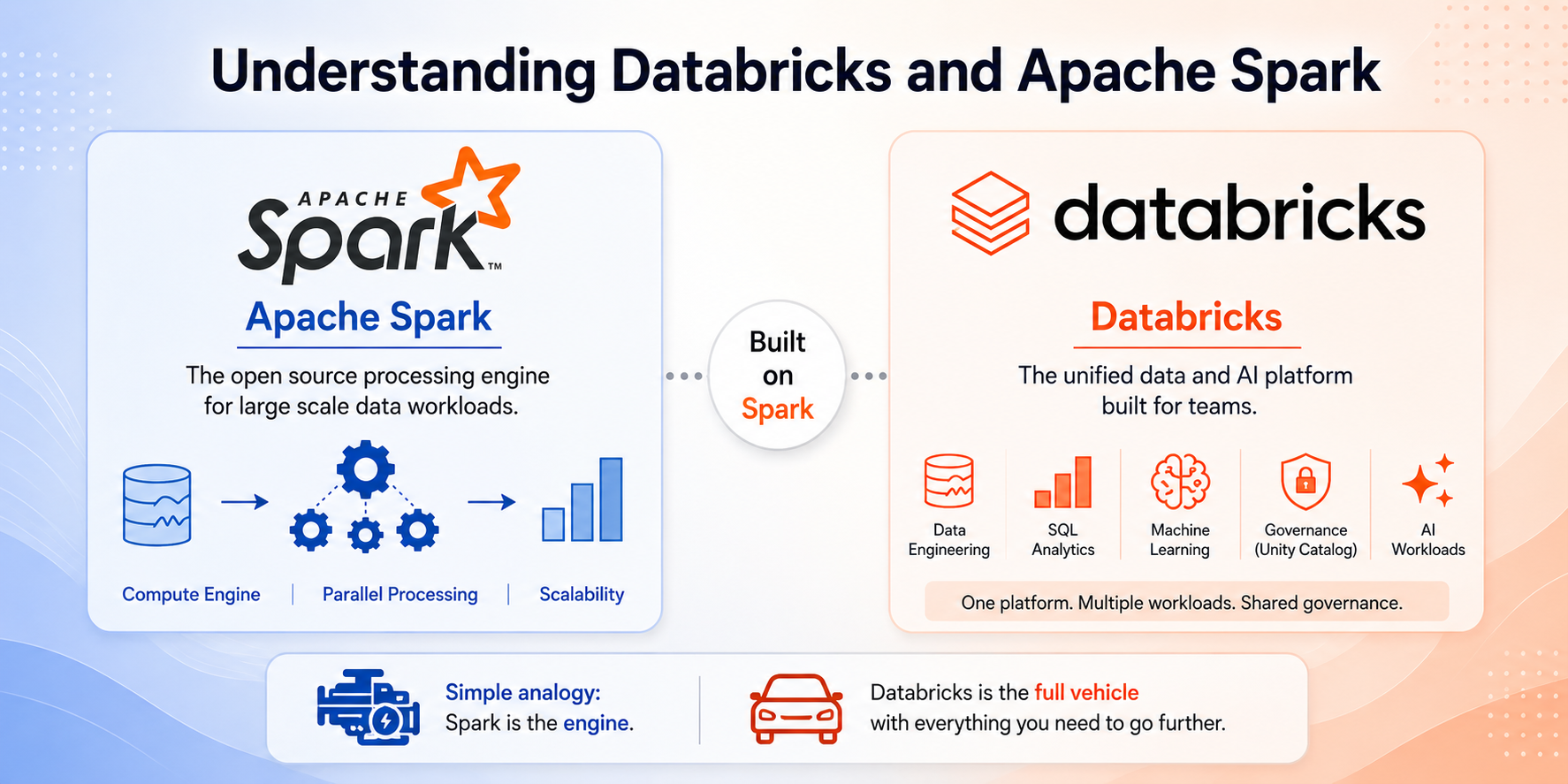
Databricks and Apache Spark are often mentioned in the same conversation, which makes people think they are almost the same thing. They are connected, but they are not the same tool.
Apache Spark is the processing engine. Databricks is a managed data platform built around Spark, Delta Lake, governance, notebooks, SQL, workflows, machine learning and AI tooling. That distinction matters because choosing Spark is not the same as choosing Databricks. One is mainly about how data gets processed. The other is about how teams build, run, govern and share data work inside a platform.
This article explains the difference in practical terms. It is written for people who understand data, but do not want a textbook explanation.
What is Apache Spark?
Apache Spark is an open source analytics engine for large scale data processing. The official Spark documentation describes it as a unified analytics engine with APIs for Java, Scala, Python and R. It also includes higher level tools for SQL, structured data processing, machine learning, graph processing and stream processing. (Apache Spark Documentation)
In simpler terms, Spark helps you process data when one machine is not enough.
Imagine you have billions of rows of web events, transactions, logs, sensor readings or customer records. You need to clean that data, join it with other datasets, aggregate it, and prepare it for reporting, machine learning or operational use. A normal database or single server might struggle with that workload, especially if the data is large, messy or stored across many files.
Spark solves this by spreading the work across a cluster of machines. Instead of one machine doing all the work, Spark divides the job into smaller tasks and runs those tasks in parallel. That is the core idea. Spark is not magic, and it does not remove the need for good data modelling, but it gives teams a powerful way to process data at scale.
Spark originally became important because it handled some workloads better than older MapReduce style systems. The early Spark paper focused on workloads that reuse the same data across multiple operations, such as iterative machine learning and interactive analysis. The paper introduced resilient distributed datasets, known as RDDs, as a way to support this kind of work while keeping scalability and fault tolerance. (Spark: Cluster Computing with Working Sets)
How Spark works at a high level
A Spark application usually has a driver and executors. The driver coordinates the work. Executors run on worker nodes and carry out the actual computation. Spark connects to a cluster manager, such as Spark Standalone, YARN or Kubernetes, which allocates resources. Once resources are available, Spark sends tasks to executors to run. (Spark Cluster Mode Overview)
That sounds technical, but the practical meaning is straightforward. Spark is designed to split work across machines. It can process large files, perform heavy joins, run transformations, support machine learning workflows and handle streaming use cases.
Spark can also be used through SQL and DataFrames. Spark SQL gives Spark more information about the structure of the data and the computation being performed, which allows Spark to apply extra optimisations. The same execution engine is used whether you express the computation through SQL or another supported API. (Spark SQL, DataFrames and Datasets Guide)
This is one reason Spark is used by different types of data professionals. Data engineers may write PySpark or Scala. Analysts may use Spark SQL. Data scientists may use Spark for larger feature engineering or machine learning pipelines. Spark is technical, but it is not only for low level distributed systems engineers.
What is Databricks?
Databricks is a cloud based data and AI platform. It is built around Apache Spark, but it is much more than a place to run Spark jobs.
Databricks gives teams a managed environment for data engineering, analytics, machine learning, governance and AI workloads. A Databricks account can manage users, groups, service principals, workspace management, Unity Catalog metastore management, billing, compliance and policies. Workspaces are the collaboration environments where users run workloads such as ingestion, interactive exploration, scheduled jobs and machine learning training. (Databricks Get Started Overview)
That is the real difference. Spark is the engine. Databricks is the wider platform that helps teams use Spark and related technologies in a controlled, collaborative and production ready way.
If a team runs Spark directly, it has to think about cluster setup, job submission, dependency management, monitoring, permissions, upgrades, security and cost control. Databricks takes on a large part of that platform layer. Engineers still need to understand their workloads, write good code and model the data properly, but they are not starting from a blank infrastructure layer.
Databricks vs Apache Spark
The common comparison of Databricks vs Spark is slightly misleading because they are not direct alternatives.
Spark is a distributed processing engine. Databricks is a managed platform that uses Spark and adds the surrounding services that companies usually need.
A simple way to understand it is to compare Spark to an engine and Databricks to the full vehicle. The engine matters because it provides the power. But the vehicle also needs controls, safety systems, navigation, maintenance tooling, a dashboard and a way for people to actually use it.
That is why many organisations choose Databricks. They do not only want the processing engine. They want a place where engineers, analysts, data scientists and governance teams can work on data without each team building its own platform around Spark.
This does not mean Databricks is always the right choice. It means the decision is not really about Spark being better or worse than Databricks. The better question is whether your team needs only a processing engine, or whether it needs a managed platform around data engineering, analytics, machine learning and governance.
Why Databricks became popular
Spark is powerful, but running Spark well inside a company is not always simple. Writing the code is only part of the work. Teams also need scheduling, monitoring, permissions, shared development environments, production deployments, auditability, data quality checks and cost management.
Databricks became popular because it reduced a lot of that operational work. It gave teams a shared place to write notebooks, run jobs, create pipelines, query data, manage access and collaborate across data engineering, analytics and data science.
The other reason is the lakehouse architecture. Databricks describes a data lakehouse as a data management system that combines benefits of data lakes and data warehouses. It is designed for organisations that want scalable storage and processing without splitting machine learning, business intelligence and data engineering into isolated systems. (Databricks Lakehouse Documentation)
The lakehouse idea is not only a Databricks marketing phrase. A 2021 CIDR paper described the lakehouse as an architectural pattern based on open direct access data formats, support for machine learning and data science workloads, and warehouse like performance. The paper argued that lakehouses could address problems such as data staleness, reliability, total cost of ownership, lock in and limited support for advanced analytics. (Lakehouse: A New Generation of Open Platforms that Unify Data Warehousing and Advanced Analytics)
What is Delta Lake?
Delta Lake is an open source storage layer used in lakehouse architectures. It adds reliability features on top of data lakes.
The official Delta Lake documentation describes Delta Lake as a project that enables lakehouse architecture on top of existing data lakes. It provides ACID transactions, scalable metadata handling, and unified batch and streaming processing on storage systems such as S3, ADLS, GCS and HDFS. (Delta Lake Documentation)
This matters because basic data lakes can become difficult to trust. Files are written. Schemas change. Jobs fail halfway through. Different pipelines read and write at the same time. Without the right table layer, a data lake can turn into a collection of files where nobody is completely sure what is correct.
Delta Lake helps by adding features such as schema enforcement, time travel, upserts and deletes. These features make data lakes more suitable for analytics and production pipelines. The Delta Lake research paper also explains the problem from a systems perspective: cloud object stores are attractive because they are cheap and scalable, but they do not naturally provide the kind of transactional guarantees that structured data workloads often need. Delta Lake was designed to provide ACID table storage over cloud object stores while still allowing access from engines such as Spark, Hive, Presto and Redshift. (Delta Lake: High Performance ACID Table Storage over Cloud Object Stores)
In practical terms, Spark provides compute, Delta Lake improves the reliability of data stored in the lake, and Databricks brings these pieces together in a managed platform.
What is Unity Catalog?
Unity Catalog is Databricks governance layer for data and AI assets. Databricks describes it as the unified governance layer built into Databricks. It enforces access control, tracks lineage, logs activity for auditing and governs assets such as tables, views, volumes, functions, models and services. (Unity Catalog Documentation)
This is an important part of the Databricks story because data platforms are not only about processing data quickly. They are also about trust and control.
In a real company, people need to know who can access sensitive tables. They need to understand where a dataset came from. They need to see which reports, models or downstream tables depend on it. They need audit logs, lineage and a consistent permission model.
Spark alone does not solve all of that. Spark can process the data, but governance needs more than compute. Databricks adds a platform layer around the work, and Unity Catalog is one of the main pieces of that layer.
The lakehouse idea in plain English
A data lake is useful because it can store large amounts of raw and varied data. It is flexible and often cheaper than putting everything into a traditional warehouse straight away. The problem is that data lakes can become messy when ownership, schema control, quality checks and governance are weak.
A data warehouse is useful because it is structured and usually better suited for business reporting. People trust tables in a warehouse because they are usually curated, modelled and governed. The problem is that warehouses can be less flexible for raw data, machine learning and some large scale processing patterns.
The lakehouse tries to bring these two worlds closer together. It keeps the flexibility of lake storage, but adds table management, governance, reliability and performance features that make the data more useful for analytics and machine learning.
Databricks says its lakehouse is built on Apache Spark, with Delta Lake as the storage layer and Unity Catalog as the governance layer for data and AI. (Databricks Lakehouse Documentation)
That is the promise. The reality still depends on implementation. A lakehouse will not automatically fix unclear metric definitions, poor source data, weak ownership or bad modelling decisions. It gives teams a stronger foundation, but the quality of the data platform still depends on the people building it.
Where Spark fits in modern data engineering
Spark is still relevant, but it is not needed for every data team.
Many smaller teams can do a lot with a cloud data warehouse such as BigQuery, Snowflake or Redshift. SQL based transformation tools can take a team a long way, especially when the data volume is manageable and the workloads are mostly reporting or standard analytics.
Spark becomes more useful when the data is large, the transformations are heavy, or the workload fits distributed processing better. Examples include large file processing, complex joins across big datasets, streaming pipelines, machine learning feature engineering and data lake processing.
This is where Databricks can be attractive. A company may want Spark’s processing power without wanting to manage Spark infrastructure directly. Databricks gives that company a managed way to use Spark, Delta Lake, notebooks, workflows, SQL, governance and machine learning tooling in one place.
When Spark alone makes sense
Using Spark without Databricks can make sense when a company already has strong platform engineering capability. Some teams want more control over infrastructure, deployment patterns, dependency management and cost optimisation. Others may need a custom setup that does not fit neatly into a managed platform.
In those cases, running Spark directly on Kubernetes, YARN or another managed cloud service can be reasonable. The trade off is that the team owns more of the operational burden.
That means someone has to manage clusters, monitor jobs, handle library versions, configure security, tune performance, control costs, manage upgrades and build a usable experience for the rest of the data team. For a mature engineering organisation, that can be acceptable. For a team that wants to focus on business data problems rather than platform maintenance, it can become a distraction.
When Databricks makes sense
Databricks makes sense when the company wants a managed platform rather than only a processing engine.
It is especially useful when several teams need to work in the same environment. Data engineers can build pipelines. Analysts can query curated data. Data scientists can train models. Governance teams can manage permissions and lineage. Platform teams can enforce policies and monitor usage.
Databricks can also make sense when a company wants to use a lakehouse architecture instead of separating raw data, warehouse tables, machine learning datasets and governance into too many disconnected systems.
The trade off is cost and platform commitment. Databricks can simplify a lot, but it is still a major platform decision. Teams need to understand pricing, workloads, cloud architecture, governance, deployment practices and how Databricks fits with the rest of their data stack.
Common misunderstanding
The most common misunderstanding is thinking that Databricks is just Spark with a nicer interface.
That view is too narrow. Spark is still central, but Databricks has become a wider data and AI platform. Its value is not only that it runs Spark jobs. Its value is that it brings together processing, storage, governance, analytics, machine learning and collaboration in one managed environment.
Another misunderstanding is assuming that Databricks will automatically make data reliable. It will not. If the source data is poor, metric definitions are unclear, ownership is weak and business logic is scattered across notebooks, Databricks will not fix that by itself.
A good platform helps, but it does not replace good data work. Teams still need clear models, tested pipelines, agreed definitions, sensible governance and a proper understanding of how the business uses data.
So, what should you take from this?
Apache Spark and Databricks are easier to understand once you separate the engine from the platform.
Spark is the distributed processing engine. It is powerful, flexible and widely used for large data workloads. It helps teams process data across clusters and supports SQL, DataFrames, machine learning and streaming workloads.
Databricks is the managed platform built around Spark and the lakehouse ecosystem. It adds the working environment around the engine: notebooks, jobs, SQL, Delta Lake, Unity Catalog, governance, machine learning and AI tooling.
For some teams, Spark alone is enough. For many organisations, Databricks is attractive because it removes a lot of platform work and gives different data teams a shared place to build and govern data products.
The practical question is not which one is better. The better question is what your team actually needs. If you need a processing engine and have the skills to manage the surrounding platform, Spark may be enough. If you need a managed environment for data engineering, analytics, machine learning and governance, Databricks may be the better fit.
Turn your data into trusted answers
Build governed metrics, explore your data, and create dashboards with Metricwise.
Get Started