Analytics
Why modern BI need a Metrics layer
Business intelligence has come a long way.
For many companies, moving from Excel-based reporting to modern BI tools was a major step forward. Dashboards made data easier to access. Reports became less manual. Teams could track performance without waiting days for someone to pull numbers together.
That progress matters.
Modern BI has helped businesses become more data aware. More people can review performance, ask better questions, and make decisions using data rather than gut feel.
But as BI adoption grows across a company, a new challenge appears.
More teams build reports. More dashboards get created. More KPIs are used in board packs, sales reviews, marketing updates, finance reports, and leadership meetings.
At that point, the question is no longer just:
“Can we see the data?”
It becomes:
“Are we all using the same definition?”
That is where a metrics layer becomes important.
What is a metrics layer?
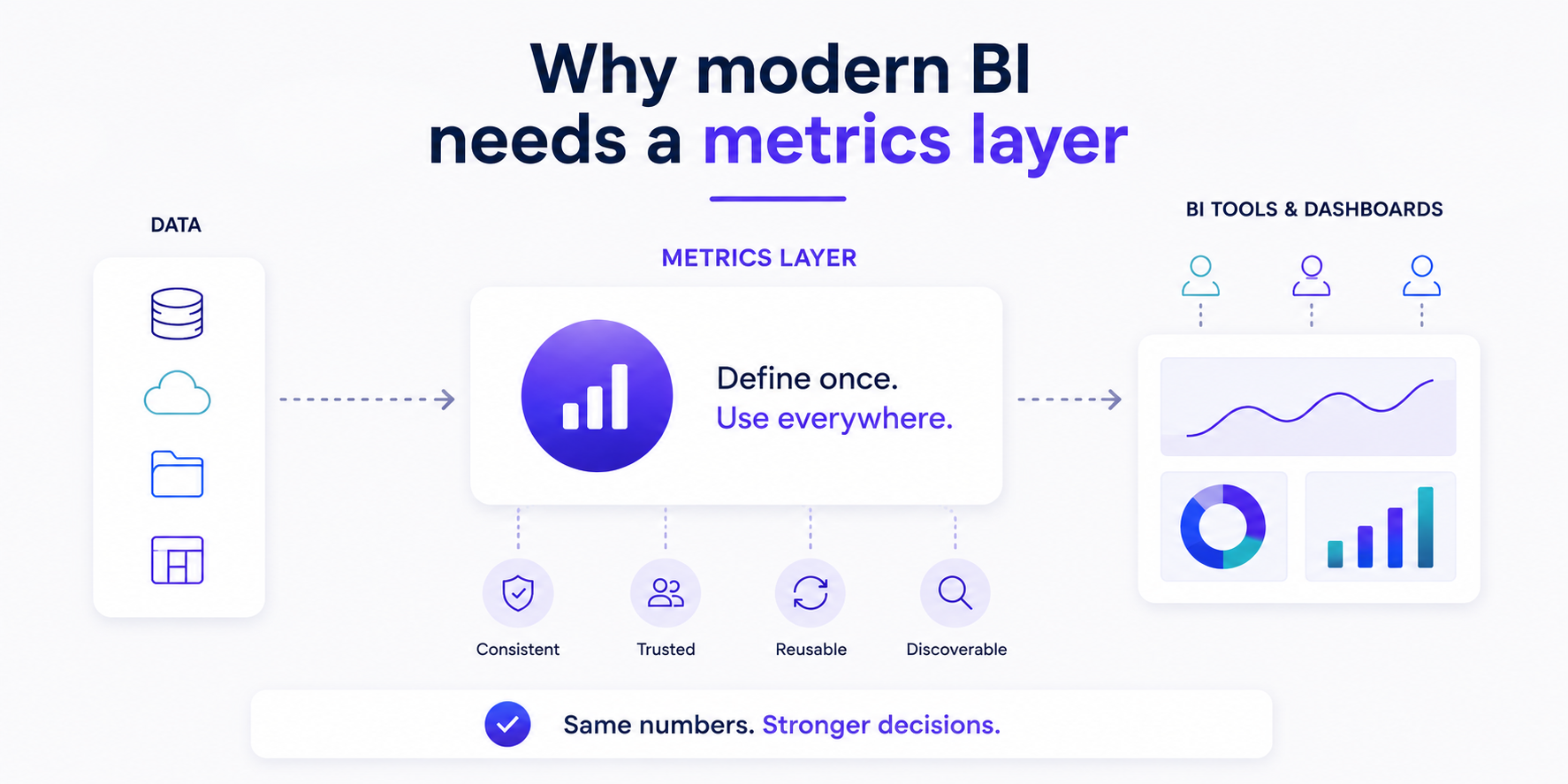
A metrics layer is the place where important business metrics are defined, managed, and reused before they appear in dashboards or reports.
It usually sits between the underlying data and the BI or visualisation tools people use every day. In some data stacks, it may sit alongside or within a semantic layer. The architecture can vary, but the purpose is simple:
Define the metric once. Use it consistently everywhere.
That means a KPI such as revenue, conversion rate, churn, active customers, or cost per lead is not rebuilt from scratch every time someone creates a dashboard.
Instead, the business has one shared definition that can be reused across teams, reports, and tools.
This is the foundation of governed metrics.
Why governed metrics matter
Governed metrics are shared KPI definitions that the business agrees on.
They help answer basic but important questions:
- What does this metric mean?
- How is it calculated?
- Which data source does it use?
- Who owns it?
- Where is it being used?
- When was it last updated?
When these questions are not answered clearly, teams can end up with different versions of the same KPI.
This does not usually happen because people are doing anything wrong. It often happens because teams are moving quickly.
Marketing builds a dashboard for campaign performance. Sales builds one for pipeline. Finance creates another version for reporting. Each team makes reasonable choices, but over time the definitions drift.
The result is confusion.
Two dashboards show different numbers for the same metric. Then the conversation shifts from “What should we do?” to “Which number is right?”
A metrics layer helps reduce that problem by giving teams a shared base to work from.
Why modern BI needs a metrics layer
The more successful a BI tool becomes, the more metric consistency matters.
If only a small group of analysts use BI, definitions are easier to manage manually. People can check with each other, document calculations, and keep things aligned.
But modern BI is more open than that.
Business users create dashboards. Teams self-serve. Leaders expect live reporting. Data is used in more places and by more people.
That is a good thing.
It also means businesses need stronger foundations.
A metrics layer supports the next stage of BI maturity. It helps keep reporting consistent as usage grows. Teams can move faster without creating a new version of every KPI.
The goal is not to slow people down with governance.
The goal is to make the trusted path the easiest path.
The value of a metric catalogue
A strong metrics layer should include a metric catalogue.
A metric catalogue gives teams a central place to find, understand, and reuse approved business metrics.
A useful metric catalogue might include:
- Metric name
- Business definition
- Calculation logic
- Data source
- Metric owner
- Last updated date
- Related dashboards or reports
This matters because governance only works when people can find what they need.
If the approved KPI definition is hidden in a technical document, people will probably create their own version. If the metric catalogue is easy to search and understand, teams are more likely to reuse existing metrics.
That makes reporting more consistent. It also helps new starters, business users, and leadership understand what a metric really means.
A catalogue turns metrics from something buried inside dashboards into something the business can manage properly.
Dashboards still matter
A metrics layer does not replace BI tools.
Dashboards and visualisation tools are still where many people consume data. They are where trends become visible, performance is tracked, and decisions are made day to day.
The point is that dashboards become more valuable when the metrics behind them are governed.
A good chart is useful.
A good chart built on a trusted metric is much more useful.
That is the shift modern BI is moving toward. It is not only about giving people access to data. It is about giving them access to numbers they can trust, understand, and reuse.
In a nutshell
The move from Excel to BI tools was a big step forward for many businesses.
The next step is making sure the metrics inside those BI tools are consistent.
That is why the metrics layer matters.
It creates a shared place for KPI definitions. It supports governed metrics. It helps teams use the same numbers across dashboards, reports, and decisions.
Modern BI has made data more visible.
A metrics layer helps make it more reliable.
Join the Metricwise waitlist
Get early access to Metricwise and we will send your workspace invite when your account is ready.